The content of many user workshops is strong. There are well-founded presentations, practical examples and valuable insights. The problem often arises afterwards: Back in your own company, the new impulses come up against existing structures, busy schedules and operational constraints. This shortens the half-life of the newly acquired knowledge faster than we would like - demonstrably less than a week.
It's not because of the topic. Nor is it the relevance. It's the way it is communicated.
Especially in times of industrial AI, data rooms and digital transformation, it is no longer enough to simply look at and understand content. It must be experienced, thought through and transferred to your own reality.
This is exactly where our user workshop comes in.
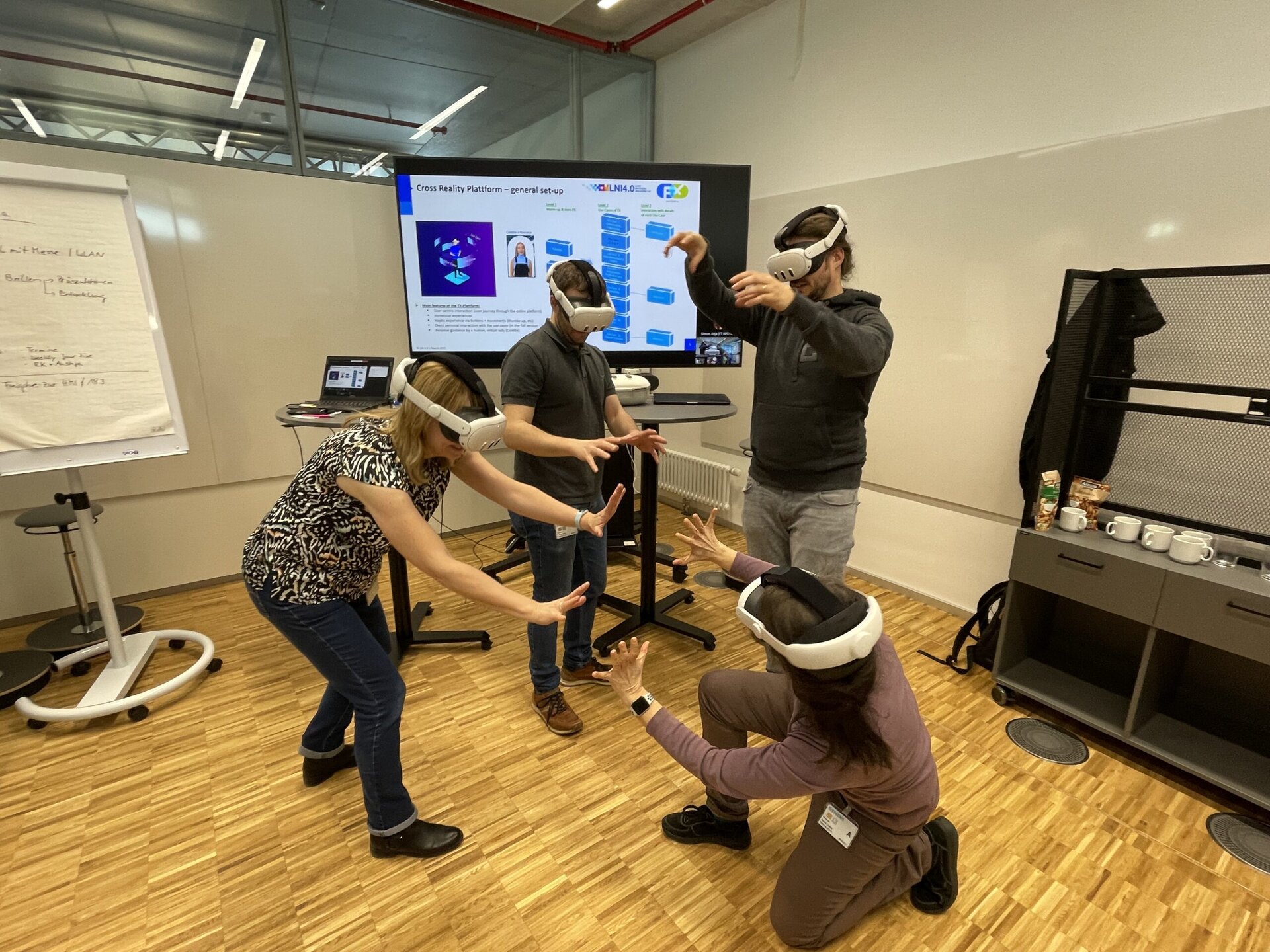
A central component is the cross-reality room. Using VR goggles - which also allow a view of the real environment - participants enter a three-dimensional learning world. Content can be experienced spatially, connections become visible and mechanisms become tangible. Interactive tasks and haptic exercises not only convey what has been learned, but also allow it to be applied directly. This form of learning activates exactly what we know from sustainable learning experiences: Those who experience something themselves anchor it much more deeply.
The second crucial building block is the individual translation into your own practice. With very real, physical methods such as Lego Serious Play the participants model their specific company situation. Processes, dependencies, interfaces - everything is made visible. The new knowledge, for example about data rooms, is not discussed in abstract terms, but is built up directly and integrated using examples. This results in surprisingly fast, tailor-made solutions, variants and further developments that fit the respective organization exactly.
The feedback speaks for itself: The Half-life of the knowledge imparted is not just a few days, but over four weeks. And in many cases, implementation has already begun by then.
That is the difference between a workshop that informs - and a workshop that empowers.
Our aim is clear: users should not just take part. They should return with clarity, motivation and concrete next steps. And that is exactly what we are designing this format for.