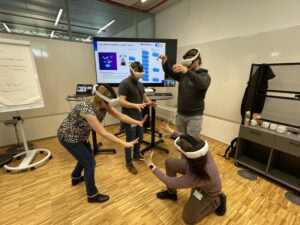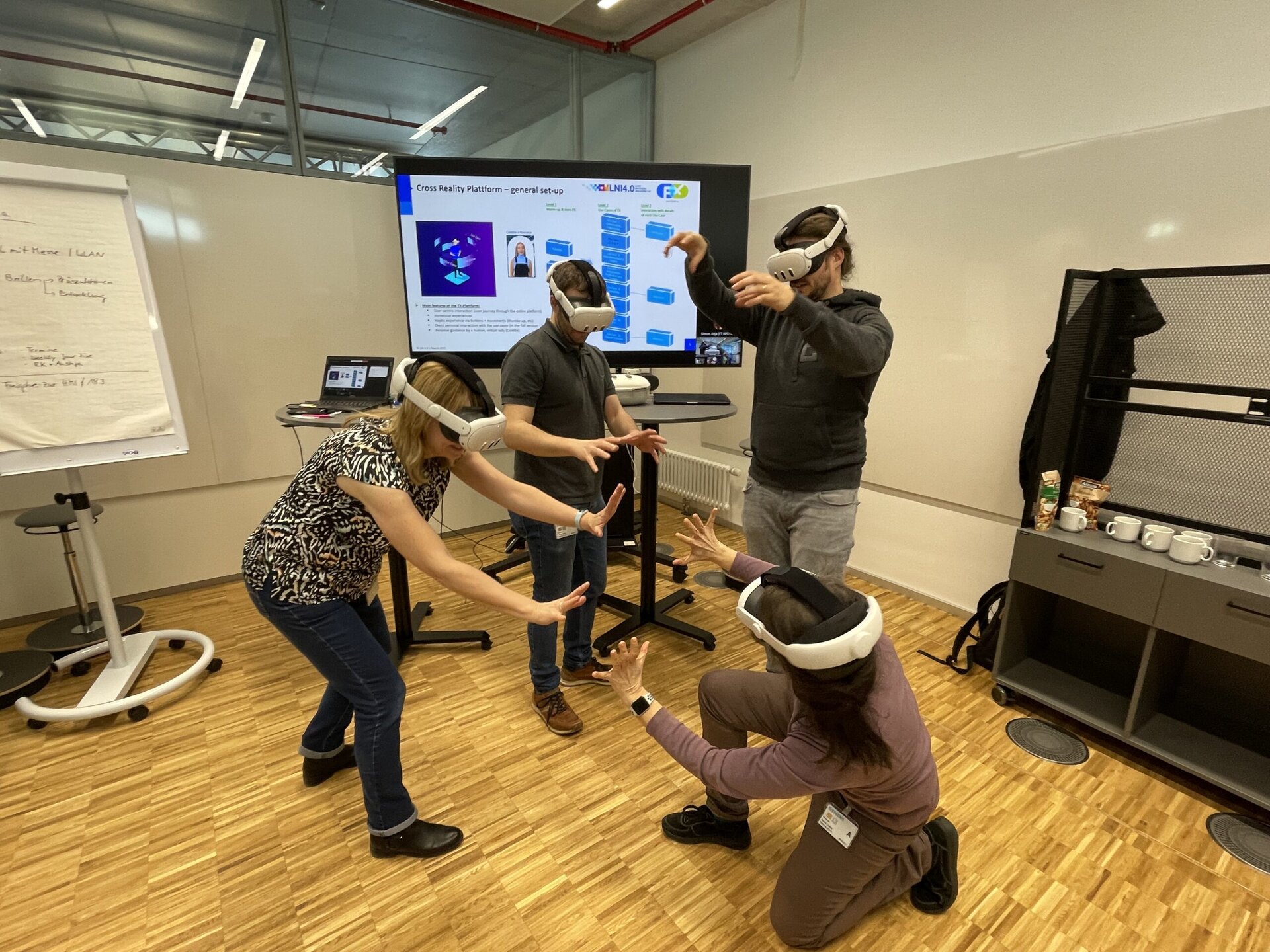
This is what it looks like in the workshop.
In the context of data spaces and Industrial AI, „erleben“ (to experience) refers to the ability of an AI system to interact with, learn from, and adapt to real-world industrial processes and data. It implies a dynamic and continuous engagement rather than a static or purely theoretical understanding. Here's a breakdown of what it means: * **Real-time Interaction and Learning:** The AI doesn't just process historical data; it actively "experiences" the ongoing operations. This means it receives live data streams from sensors, machines, and systems within the data space. * **Adaptation and Improvement:** Through this continuous experience, the AI learns the nuances, variations, and anomalies of the industrial environment. It can then adapt its models, predictions, and recommendations to improve performance, identify early warning signs, and optimize processes in real-time. * **Understanding Context:** "Experiencing" allows the AI to grasp the context in which data is generated. It understands how different operational parameters affect outcomes, a crucial component for effective Industrial AI. * **Feedback Loop:** It creates a strong feedback loop. The AI's actions or insights derived from its "experience" influence the industrial process, and the subsequent results become new data for the AI to "experience" and learn from. * **Developing Intuition (Analogous to Human Experience):** While not true intuition, the AI develops a sophisticated understanding of how systems behave, akin to how a human operator develops experience over time. It can start to anticipate problems or suggest optimal settings based on patterns it has "experienced." * **Role in Data Spaces:** In data spaces, "erleben" signifies the AI's ability to securely access and integrate data from various sources, forming a comprehensive picture of the industrial ecosystem. It "experiences" the interconnectedness of different operational units. * **Beyond Simulation:** It's about going beyond simulated environments or offline analysis. The AI is actively "living" and learning within the operational reality of the factory or industrial plant. In essence, when we talk about an AI "experiencing" in data spaces and Industrial AI, we mean its capacity for **embodied, continuous, and adaptive learning within the dynamic environment of industrial operations.**
The following examples show typical situations – presented in the cross-reality space (XR).
On the one hand, XR enables haptic experience – and on the other hand, it awakens the understanding of why exactly the difference arises in and with data spaces.
Understand machines – don't just describe them!
Participants interact directly with a virtual machine.
Through interaction, the necessary information on the individual components is opened up in a targeted way:
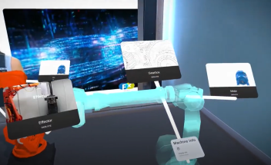
Which specific overhangs are installed?
How are they powered?
What performance data is available?
The data is not gathered from anywhere, but rather via the respective data room structured and uniform represented – based on the logic of the administration shell.
What previously had to be painstakingly gathered from various sources (you know the endless phone calls, right?!) is now immediately available and understandable.
Data becomes tangible and applicable with pinpoint accuracy!
In another scene, it becomes clear which machine data are actually relevant:
Temperature, length, weight, dimensions – everything can be directly changed and experienced.
Instead of abstract values, XR creates an experience and a feeling for it, how data affects real-world systems.
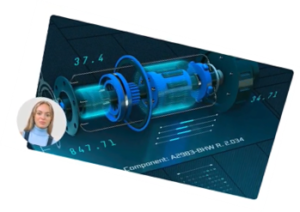
Choosing the right component for the machine – no detours!
A particularly practical scenario:
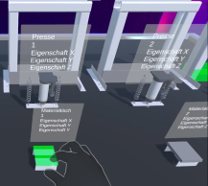 Two presses are available.
Which one is suitable for the specific application?
In the workshop and in XR, exactly the data that is relevant for this decision becomes visible:
Performance, size, applications.
What in reality has often required multiple votes and follow-up questions so far, now happens in data rooms in the shortest possible time – data-driven and transparent.
Identify vulnerabilities before they become a problem!
Existing systems can also be analyzed.
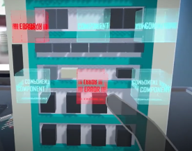 In a control cabinet, it becomes visible which components no longer meet new requirements. These are marked directly and can be specifically identified.
The effect: Participants immediately recognize, where adjustments are necessary – and why.
Understanding Compatibility – Before Integration!
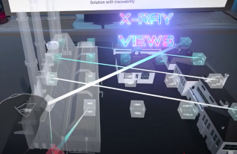 Another scenario shows changed delivery flows between stations.
Immediately it becomes visible:
Which machines and data fit together?
Where do fractures occur?
Compatibility is visually represented - clear, unambiguous, and without room for interpretation.
Here's where the real added value of data rooms becomes apparent:
Connections become visible before problems arise.
Why that makes a difference
These examples show what it's all about:
Knowledge doesn't remain abstract.
It will be tangible, verifiable, and directly applicable.
And that's exactly why it doesn't just remain with understanding – but leads to implementation.